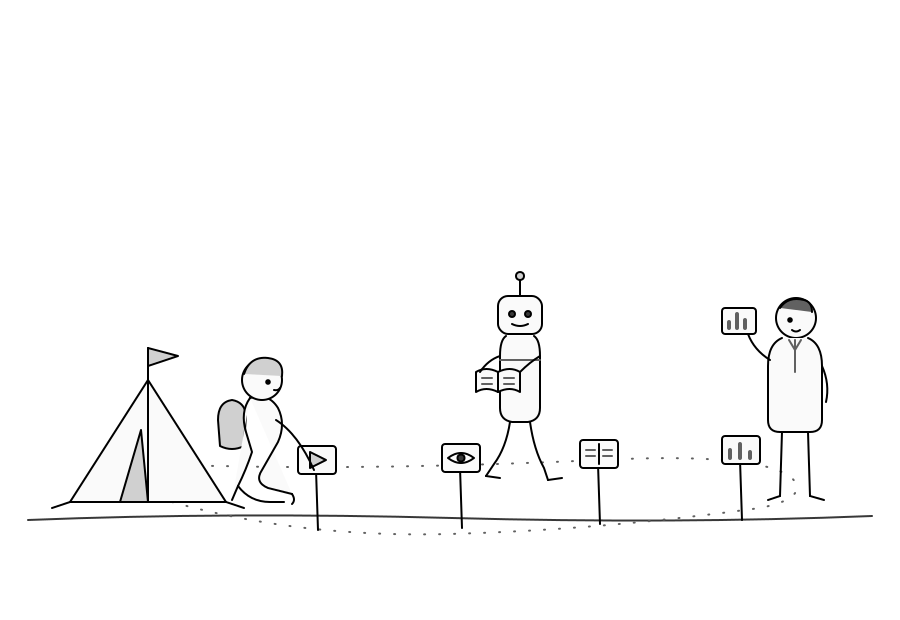
Teams that want to run coding agents continuously end up rebuilding the same plumbing: a bootstrap script, a session harness, somewhere for traces to go, somewhere for memory to live, and a way to tell real improvement from noise. Gemba packages that loop as one platform. In Lean practice, gemba is the actual place where the work happens — this platform is where your agent team does.
One loop, two surfaces
The runtime loop is stand up → run → see → remember → measure. Gemba ships it twice — as commands for a terminal, and as composite actions for CI — so what a team rehearses locally is exactly what runs on every push.
The command family
| Step | Command | What it does |
|---|---|---|
| Stand up | fit-install.sh / bootstrap |
Install the pinned toolchain and the platform CLIs |
| Run | gemba-harness |
Run agents and capture NDJSON traces — single agent or multi-agent sessions |
| See | gemba-trace |
Download, query, and analyze the traces
gemba-harness produced
|
| Remember | gemba-wiki |
Persistent wiki memory: boot digests, claims, memos, integrity audits |
| Measure | gemba-xmr |
Wheeler/Vacanti XmR control charts over the team's metric CSVs |
Two more commands round out the family:
gemba-benchmark proves whether an agent change helped
with pass@k evidence, and gemba-selfedit gives a
sandboxed agent a narrow, audited path to edit its own instruction
files.
Every command installs with the platform package and runs standalone:
npx gemba-harness run --task-file=task.md --output=trace.ndjson
npx gemba-trace overview --file trace.ndjson
npx gemba-wiki boot --agent staff-engineer
npx gemba-xmr analyze wiki/metrics/team/2026.csv
The CI actions
The same loop runs in GitHub Actions through four published composite actions, each pinned by SHA in consuming workflows:
| Step | Action | What it does |
|---|---|---|
| Stand up |
forwardimpact/bootstrap
|
The FIT environment: Bun, cached workspace, wiki checkout, pinned CLI binaries |
| Run |
forwardimpact/harness
|
Execute an agent task via gemba-harness and
upload the trace
|
| Remember |
forwardimpact/wiki
|
Run a gemba-wiki memory command with a freshly
minted token
|
| Measure |
forwardimpact/benchmark
|
Run gemba-benchmark families across machines and
merge reports
|
What becomes possible
For Teams Using Agents
Stand up and operate an agent team on one platform: bootstrap the environment, run sessions, inspect traces, persist memory, and measure outcomes. The evidence never evaporates — every session leaves a trace, every finding lands in shared memory, and every metric lands on a control chart that separates real change from fluctuation.
For Platform Builders
The platform is a consumer of published runtime libraries, never a
wrapper around them. When you need the components rather than the
commands, import the libraries directly —
@forwardimpact/libharness for sessions and traces,
@forwardimpact/libwiki for memory,
@forwardimpact/libxmr for control charts. Gemba adds no
importable API of its own; see the
library guides for the API surface.
Kata: the reference tenant
Kata — the autonomous agent team
that plans specs, ships features, studies its traces, and acts on
findings — runs on exactly this platform, daily. Kata proves the
substrate is generic: its skills invoke the same
gemba-* commands and its workflows pin the same four
actions any other team would. Nothing in the platform knows Kata
exists.
Getting Started
The bring-up layer is the bootstrap action and its
installer. In CI:
- uses: forwardimpact/bootstrap@v1
  with:
    clis: gemba-harness gemba-trace gemba-wiki
On a workstation, the same installer bootstraps with one line —
substitute the newest gear@v* tag from the
releases page:
curl -fsSL https://github.com/forwardimpact/monorepo/releases/download/<gear-release>/fit-install.sh | bash
Or install the command family from npm:
npm install -g @forwardimpact/gemba
gemba-harness --help
Contributors working inside a Forward Impact-style monorepo get the
same environment from scripts/bootstrap.sh, which the
bootstrap action also runs in CI.